


ExpeditionExpedition
Tibesti Traverse
Eighteen days of expedition to the roof of the Sahara: Emi Koussi, the Trou au Natron and the Soborom springs.
- Duration
- 18 days
- Group size
- 4–8
Sahara
The roof of the Sahara
The Tibesti is the highest massif in the Sahara. Its volcanoes — Emi Koussi, Tarso Toussidé, Tarso Emissi — rise over a sea of black stone punctured by giant calderas. This is the country of the Toubou, renowned for their endurance and their knowledge of the desert. The range remains hard to reach and access depends closely on the security situation; we only run departures when conditions allow.
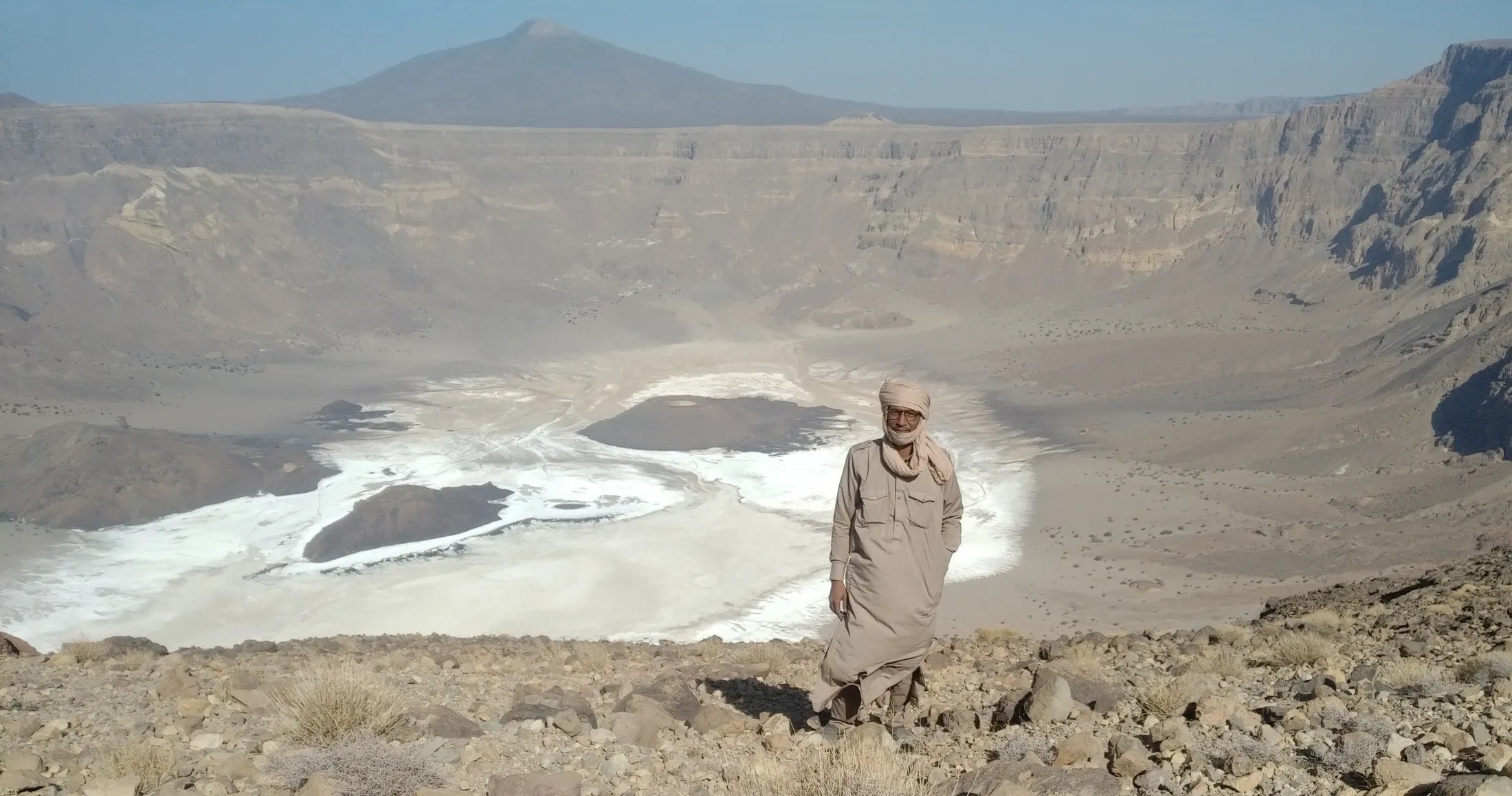
The Tibesti was born of volcanism, less than ten million years ago, on an upwarp of the African plate. Activity continued until very recently in geological terms: the fumaroles of Soborom are still active today, and the Trou au Natron — Doon Orei in Toubou — is a caldera 8 km across and 1,000 m deep, its white sodium-carbonate floor cutting sharply against the black rock.
Emi Koussi, at 3,415 m, is the highest point in the Sahara and in all of Chad. It is a shield volcano 60 to 80 km wide, whose resemblance to certain Martian formations has made it a reference site for planetary scientists.
The massif has been inhabited since prehistory. The Toubou — Teda in the north, Daza in the south — built an economy of caravan trade, herding and cultivation in the palm groves of the gorges. Bardaï and Zouar are its main centres.
Sites & heritage
Galerie
Our journeys
Eighteen days of expedition to the roof of the Sahara: Emi Koussi, the Trou au Natron and the Soborom springs.