


CulturalModerate
The Gerewol of the Wodaabe
Ten days in September–October to attend the great Wodaabe gathering, dates confirmed by the rains.
- Duration
- 10 days
- Group size
- 4–8
Sahel
The parade where it is the men who make themselves beautiful
The Wodaabe — also called Bororo — are a Fulani subgroup who have remained nomadic zebu herders, present in Chad, Niger and Cameroon. The Gerewol is their great annual gathering, at the end of the rains, when the pastures allow scattered clans to come together.
The Gerewol inverts what many societies take for granted: here it is the man who adorns himself to be chosen.
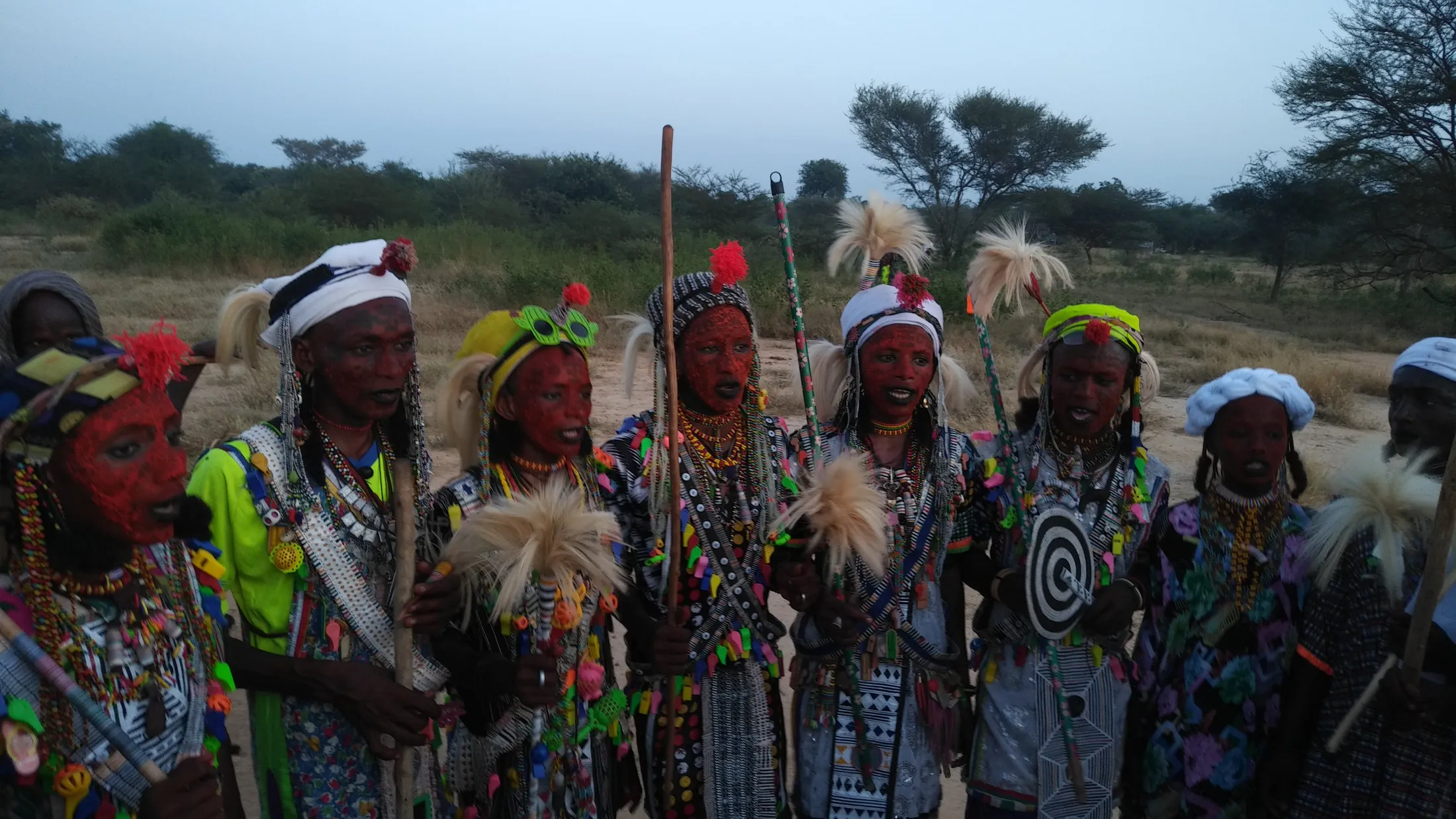
For hours, under a crushing sun, young men dance the yaake in a line. They have covered their faces in red or yellow ochre, outlined their lips in black to set off the whiteness of their teeth, drawn a white line down the ridge of the nose to lengthen it. They wear ostrich feathers, necklaces, embroidered tunics.
The Wodaabe canon of beauty is precise: height, slenderness, the whiteness of eyes and teeth. Dancers roll their eyes, widen them, bare their teeth in codified grimaces — each expression is a technical demonstration, held as long as possible without breaking rhythm.
Young women, chosen for their judgement, walk along the line and point out the one who has convinced them. The choice is entirely theirs. It may lead to a union — the marriage 'by choice', teegal, distinct from the arranged childhood marriage, koobgal.
The Gerewol has no fixed date: it depends on the rains, and so on the pastures. We never schedule it far in advance, but we know where and when to ask.
Sites & heritage
Galerie
Our journeys
Ten days in September–October to attend the great Wodaabe gathering, dates confirmed by the rains.